
PULGAR ARRIBA Si te gusta esta entrada

domingo, 4 de septiembre de 2022


Labor Day, Workers’ Rights at US Colleges

https://learningenglish.voanews.com/a/labor-day-workers-rights-at-us-colleges/6727510.html
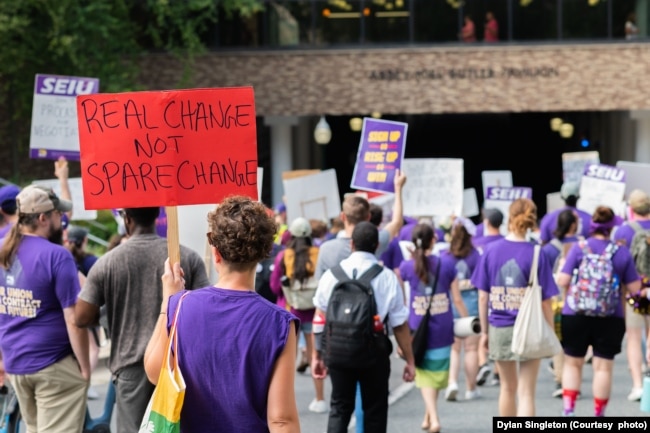
Those arriving at colleges this year might see office workers, researchers, or graduate assistants on strike. A strike is when workers decide not to do their job as a way to ask for more money or better working conditions.
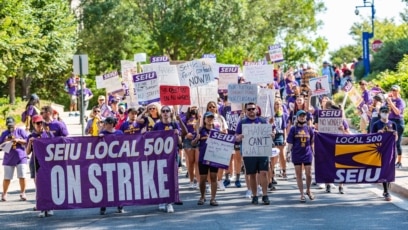
That is what happened in late August at American University (AU) in Washington, D.C.
Linda Golden works in the career center at AU. She was one of about 500 staff members who stopped working to ask for a better contract. Golden said she and other workers wanted to be sure they could cover the cost of living in Washington, D.C. They also felt that workers were being asked to do more work because the school was slow to replace people who left for new jobs.
At a large meeting for first-year students on August 26, many walked out when the university president began speaking. They gathered outside to support the striking workers, saying “pay your staff.” Within two days, the university announced that it had reached a temporary agreement to pay the striking workers more.
Golden called the agreement “a step in the right direction.” And she had a message for international students who might be in the U.S. for the first time.
“I think it’s important for students coming to the U.S. to know that we have, as workers, the right to organize, to make a case for ourselves and to fight for better working conditions. Everyone deserves to make fair wages and earn a living. And when that's not the case, we also have a right, a legal right, to organize to demand improved conditions.”
Forming a union
The rights that Golden describes have been in place since 1935 in the U.S.
That was the time Congress passed the National Labor Relations Act to provide workers with the right to organize, seek representation and fight for better working conditions. The law protects American workers who act together to address work conditions, with or without representation from labor unions.
When people think of labor unions, they usually think of people who are working in factories or coal mines. In recent years, workers at companies like Starbucks and Amazon are forming their own unions.
And some of the most important conversations about workers’ rights are going on at American colleges among graduate students and those who play sports such as American football and basketball.
In the past, graduate students who also held jobs as teaching or research assistants received a small payment and reduced tuition for helping to teach or do research. Now, graduate and research assistants can ask for help from their unions if they feel like they are being treated unfairly.
There are unions representing them at Columbia, Harvard and New York University. In California, students at 10 schools in the University of California system became unionized in late 2021.
Athletes gain money, seek protection
The graduate assistants’ success in forming unions has led college students who play sports to think about how they can organize to get more from the schools.
The Big Ten Conference is made up of major schools like Ohio State University, Pennsylvania State University and the University of Michigan. Recently, the organization signed a contract with several television broadcasters that will bring in $7 billion over the next seven years. The broadcasts will show games played by student/athletes who receive not much more than a small payment and tuition.
Dan Murphy writes about college football for ESPN. For years, Murphy said, there has been talk of a union in college football, but the last serious attempt failed in 2014.
Now that some student athletes are making hundreds of thousands of dollars on what is known as name, image and likeness agreements, they have more power than in the past. Murphy noted that some also have agents who help them with making deals.
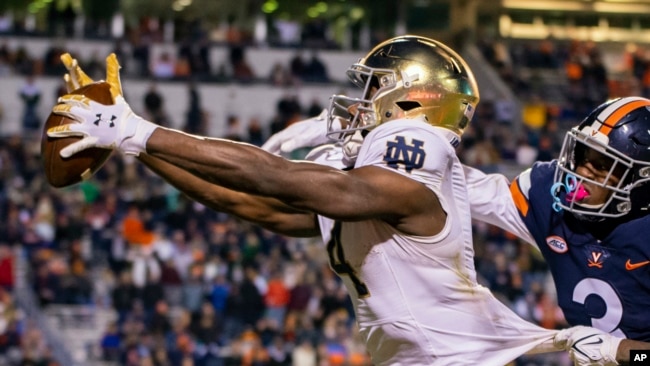
“If college athletes could ever organize their voices and kind of act in unison, they would have so much leverage that the NCAA would have to sort of cave and really change their business model.”
Murphy also noted that the unions might be able to help college athletes have more time away from their team or more time to rest after games.
“The NCAA has rules that you're supposed to only spend about 20 hours a week or so on your sport when you're in season. But no one really follows those.”
Many workers in the U.S., however, will get the day off on Monday in honor of Labor Day, a holiday that started in 1882.
I’m Dan Friedell.
Dan Friedell wrote this story for VOA Learning English.
Quiz - Labor Day, Workers’ Rights at US Colleges
_______________________________________________________________________
Words in This Story
graduate –adj. relating to studies taken at a university after earning a bachelor’s degree
staff –n. a group of people who work for an organization
deserve –v. used to say that someone or something should be given something
labor union –n. an organization of workers
tuition –n. the amount of money paid to a school for the right to study there
likeness –n. a drawing or photo of what a person looks like
unison –adj. doing something together at the same time
leverage –n. influence or power used to achieve a desired result
cave –v. to stop trying to resist something or give in
_______________________________________________________________________
We want to hear from you. Does your country have strong labor unions? Are students part of them?
We have a new comment system. Here is how it works:
Write your comment in the box.
Under the box, you can see four images for social media accounts. They are for Disqus, Facebook, Twitter and Google.
Click on one image and a box appears. Enter the login for your social media account. Or you may create one on the Disqus system. It is the blue circle with “D” on it. It is free.
Each time you return to comment on the Learning English site, you can use your account and see your comments and replies to them. Our comment policy is here.
miércoles, 15 de junio de 2022
NIÑA DE 7 AÑOS ENTRA A LA UNIVERSIDAD, NIÑA SOBRESALIENTE EN MATEMÁTICAS...
Cómo te parece esta niña?= ponle atención a este vídeo
ENTREVISTA CON SHAKIRA- EL AMOR O GUSTO POR LOS IDIOMAS
Hay muchas personas quienes por gusto o por necesidad se entusiasman con comunicarse con otros en varias lenguas, Shakira es una de ellas, y quiero que esto entusiasme también a los jóvenes quienes lean este blog, escuchen esta entrevista y también tome amor a las lenguas, especialmente al Inglés
jueves, 19 de mayo de 2022
LIVERPOOL CHAMPION- Jurgen Klopp’s words about Luis Díaz
EINTRACHT FRANKFURT VS. GLASGOW RANGERS EURO LEAGUE FINALE STADIONVLOG🔥GESCHICHTE GESCHRIEBEN
martes, 15 de marzo de 2022
Face Covering Requirements End, But Some US Parents Are Worried (tomado de VOA) March 15, 2022

Major school districts around the United States are permitting students to attend class without face coverings for the first time in nearly two years. The rules relating to face coverings, or masks, have caused fights among educators, school boards and parents throughout the COVID-19 pandemic.
New York City is the largest school district in the country. It ended its mask requirement on March 7. Philadelphia lifted its school mask requirement on March 9. It joined other big cities such as Houston and Dallas that made similar moves in the past week. Chicago schools ended their mask requirement Monday.
Parents, teachers and school leaders all must balance the new rules. Some families are happy that their children no longer have to wear masks. But others say they are still worried and are urging their children to continue wearing face coverings for now.
Educators are caught in the middle.
In Anchorage, Alaska, top school official Deena Bishop says lifting the mandate in the city’s nearly 100 public schools was a welcome change. She said there were months of arguments over masks.
“So I’m glad that we’ve taken that fight away…and now we can go back to focus on learning,” Bishop said.
Falling COVID-19 infection rates and new federal health recommendations are leading states to drop the requirements. The Centers for Disease Control and Prevention recently issued new guidelines saying most healthy Americans, including students, can safely stop wearing masks.
But those who disagree about ending school mask requirements often point to low vaccination rates among American children. Only about 25 percent of children ages 5 to 11 have been fully vaccinated against the coronavirus. Just 58 percent of children ages 12 to 17 are vaccinated, the CDC says.
 New York, Connecticut, Massachusetts, Illinois and Delaware recently lifted their statewide school mask requirements. New Jersey and Rhode Island officially dropped theirs last Monday. California, Oregon and Washington all dropped their statewide mandates on March 12.
In many places, the decisions are being made at the local school district level.
Officials in many large cities, such as Boston, Los Angeles and Washington, D.C., have said they will keep mask rules for now. Officials say that could change if vaccination rates rise among their students or if they can reach agreements with teachers unions. Unions have been strong supporters of keeping the mask requirements in place.
Chicago schools announced last week that masks will no longer be required starting March 14. The city's teachers union then promised to take officials to court. They said the move will break an agreement with the district to keep the mask rule through the end of the school year.
In New York City, elementary school student Jack Jalaly stopped wearing his mask when they became optional. For children, “it’s really great because you can see the way words are pronounced and you can see spellings,” said Jack's mother, Andrea.
But third-grad student Derrick Carter-Jacob kept his mask on even after New York removed the requirement.
“Leave it on. There’s no reason for him to take it off until basically everybody is safe,” said his parent, Michael Jacob.
John Bracey is a Latin teacher at Belmont High School near Boston, Massachusetts. He said he will keep wearing his mask through the end of the academic year, even if district officials decide to end the mandate.
“I have major concerns on so many levels,” Bracey said. “I just can’t find a public health or moral justification for removing them.
”
Melissa Bello is a parent in Needham, Massachusetts, outside Boston. She said her two children were among those who happily removed their masks last week.
She said her 8-year-old son has hearing loss and has had trouble understanding what people are saying when they wear masks.
“He’s working harder every day in school and coming home more tired,” Bello said. “There’s not enough consideration for those kinds of tradeoffs in these mask mandates.
”
I’m Dan Novak.
Dan Novak adapted this story for VOA Learning from reporting by The Associated Press.
THERE IS A QUIZ
IF YOU WANT TO MAKE IT YOU MUST TO GO HERE:
Ir al final de la siguiente pág. Para resolver el QUIZ propuesto: https://learningenglish.voanews.com/a/face-covering-requirements-end-but-some-us-parents-are-worried/6475921.html?ltflags=mailer
Suscribirse a:
Entradas (Atom)
Forum